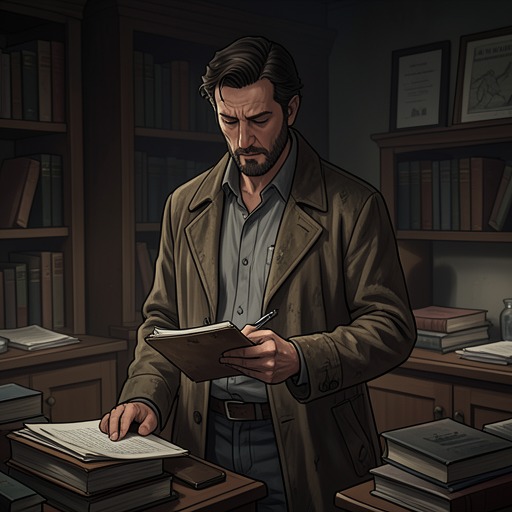
Martin submits his early writing and faces rejection
Martin EdenMartin Eden’s early attempt to earn a living as a writer begins with fierce confidence and almost no knowledge of how publishing works. He drafts an article, learns the conventions he has overlooked, and sends his work into a market that answers him with rejection, delay, or silence. The campaign establishes both his capacity for sustained self-teaching and the gap between producing work and gaining recognition or payment.
The First Manuscripts
After arriving in Oakland with his pay-day money, Martin takes up his old room at Bernard Higginbotham’s and begins an article about treasure hunters. He does not tell Ruth Morse he has returned; he plans to see her once the piece is finished. To estimate its length, he counts the words in a double-page article in the Sunday supplement of the San Francisco Examiner. Three days of intense work produce a draft, but a rhetoric book teaches him that he needs paragraphs and quotation marks, so he rewrites it while consulting the text. A newspaper item then gives him another rule to learn: manuscripts should be written on one side of the paper and sent flat, not rolled. He has violated both instructions and copies the piece a third time.
Those practical discoveries mingle with a young writer’s optimistic arithmetic. Reading that leading newspapers pay at least ten dollars a column, Martin calculates that ten columns might bring him one hundred dollars. He imagines that writing will buy the freedom and presentable clothes he needs, while bringing him nearer to Ruth. He mails the manuscript in a flat envelope to the Examiner, assuming that acceptance would mean immediate publication. Because it goes out on Friday, he expects it in the following Sunday’s paper and imagines that the article itself will announce his return to Ruth.
He is already planning what to write next. In the reading room, he studies issues of The Youth’s Companion and finds serials commonly arranged in five instalments of about three thousand words, with some running to seven. He chooses the longer form and draws on his own experience of a whaling voyage in the Arctic, which had ended in shipwreck after six months rather than the planned three years. His two boy heroes are fictional, but their adventures grow from work and events he knows. By Saturday evening he has completed the first three-thousand-word instalment. Jim finds the enterprise amusing, while Bernard Higginbotham derides the idea of Martin as a literary man.
A Self-Taught Working Routine
When the Sunday Examiner arrives, Martin searches it anxiously for his article. Finding nothing, he reads the paper again, then concludes that publication may take longer than he supposed and that the piece may lack news value. He has told no one about the submission, which spares him from having to explain its absence. Instead, he returns to his serial, stopping to consult a dictionary or rhetoric book and using the pauses to study chapters. Each day for a week he writes three thousand words; each evening he examines magazines and weeklies in the reading room to see what editors publish. A report in Book News that first-class magazines pay two cents a word makes the day’s instalment seem potentially worth sixty dollars to him—about two months’ wages at sea.
Martin’s ambition is not confined to prose. While working on a pearl-diving article, he repeatedly breaks off to attempt love poems inspired by Ruth. He can manage metre and rhyme, but cannot reproduce the quality he senses in great poetry; defeated by the difference between technical correctness and the elusive effect he seeks, he returns to prose. He then writes articles about the sea as a career, turtle-catching, and the northeast trade winds, followed by six short stories that he sends to different magazines. His days expand around writing and study: he cuts his sleep to five hours, reads at the library and reading room, and continues working with an intensity that makes his cramped home life recede from attention. The early submissions belong to a larger effort to teach himself both what to write and how to make it legible to the institutions that might publish it.
Rejection, Revision, and Material Pressure
The first clear answer is a rejection. A month after Martin mails the boys’ serial, The Youth’s Companion returns it with a tactfully worded slip. The Examiner provides no comparable courtesy. After waiting two weeks, Martin writes to its editor; a week later he writes again. At the end of the month he goes to San Francisco to call in person, but an office boy prevents him from reaching the editor. In the fifth week the manuscript comes back by mail without comment or explanation. His articles fare no better at other leading San Francisco papers. When he recovers them, he sends them east to magazines, which return them more quickly with printed rejection slips.
The short stories also come back. Martin rereads them and cannot understand their rejection until a newspaper advises that manuscripts should be typewritten. He rents a typewriter, teaches himself to operate it in a day, types new work, and retypes earlier pieces as they return. The typed manuscripts are rejected too, but he responds by sending them to new editors rather than abandoning the attempt. He tests his judgment by reading stories to Gertrude Higginbotham; she listens with glistening eyes and pride, and praises his writing. Her encouragement offers a contrast to the impersonal responses from editors, but it does not resolve the question of why his work fails to find a market.
As the weeks pass, Martin’s money dwindles and no income comes in. Later, The Transcontinental publishes his story The Ring of Bells but does not send the promised five dollars. Martin writes regularly for payment, sometimes receiving only evasive replies; while waiting for one, he goes hungry for two days and pawns his bicycle. He also discovers that an article he sold to a Chicago newspaper for ten dollars has appeared in print, though the editor ignores his letters about the money. These experiences make rejection only one part of the problem: even publication does not guarantee that an author will be paid. Martin understands the withheld fees as the loss of the goods he has made and the means by which he hopes to obtain food.
From the Gate to the Market
Martin adapts not only his manuscripts but his methods. Later he constructs stock forms for commercial storiettes, turning their composition into a repeatable process. Yet a completed story can still be published without payment: after The Transcontinental prints The Ring of Bells, it delays Martin’s fee despite his repeated requests. When he eventually confronts the magazine’s staff, he asks directly for the five dollars promised on publication. The episode gives the earlier submission struggle a sharper consequence: editors and publishers control not only entry into print but also whether the writer receives the agreed return.
The eventual reversal is measured in the treatment of his work. After Martin’s writing gains recognition, editors who had rejected manuscripts begin requesting them. The Northern Review asks for more essays after publishing The Cradle of Beauty, while Burton’s Magazine offers five hundred dollars apiece for five pieces. Martin counters at one thousand dollars each; Burton’s accepts his price for five, and Mackintosh’s Magazine buys four more at the same rate. The manuscripts had previously been refused by the very magazines now seeking them. This change does not make the early work different in retrospect; it makes visible the role reputation plays in determining what editors will read, publish, and pay for. Martin’s first campaign therefore traces more than a novice’s progress in craft: it shows how persistence meets an editorial system whose judgments can shift dramatically once an author becomes valuable to the market.